Healthcare delivery is no longer in the walls of a hospital. With the fast growth of teleradiology and telemedicine, clinicians and radiologists are now greatly relying on digital infrastructure to access, interpret and share medical images remotely. The most significant aspect of this change is the DICOM medical viewer a key tool that facilitates a smooth visualization, analysis, and collaboration within a distributed healthcare setting.
Although conventional imaging processes relied on workstations on-premises, the modern healthcare ecosystem requires real-time, web-based access to diagnostic-quality images across devices and locations. DICOM viewers too have been improved to be not only image display devices, but also vital components of cloud-based imaging workflows, remote diagnostics, and collaborative care delivery.
This paper discusses the DICOM medical viewers that drive teleradiology and telemedicine, the technology underpinning them, and why they are invaluable to healthcare providers today.
DICOM viewers have become a key provision in the infrastructure in current healthcare delivery especially in teleradiology settings as well as telemedicine settings. The fact that they can facilitate remote access, real-time collaboration and effective workflows makes them a pillar of digital imaging strategies.
• The Dicom Viewers Play A Pivotal Role In Telemedicine And Remote Diagnostics.
• Traditional Desktop Systems Are Being Phased Out In Favor Of Web-based And Cloud-native Systems.
• On-the-fly Collaboration And Availability Enhance Clinical Effectiveness.
• Security, Integration And Performance Should Be Put Into Consideration.
• The Future Of Imaging Interpretation And Workflow Optimization Is Being Influenced By Ai Integration.
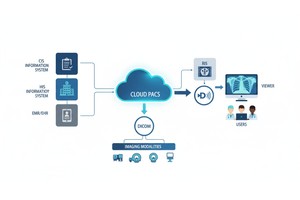
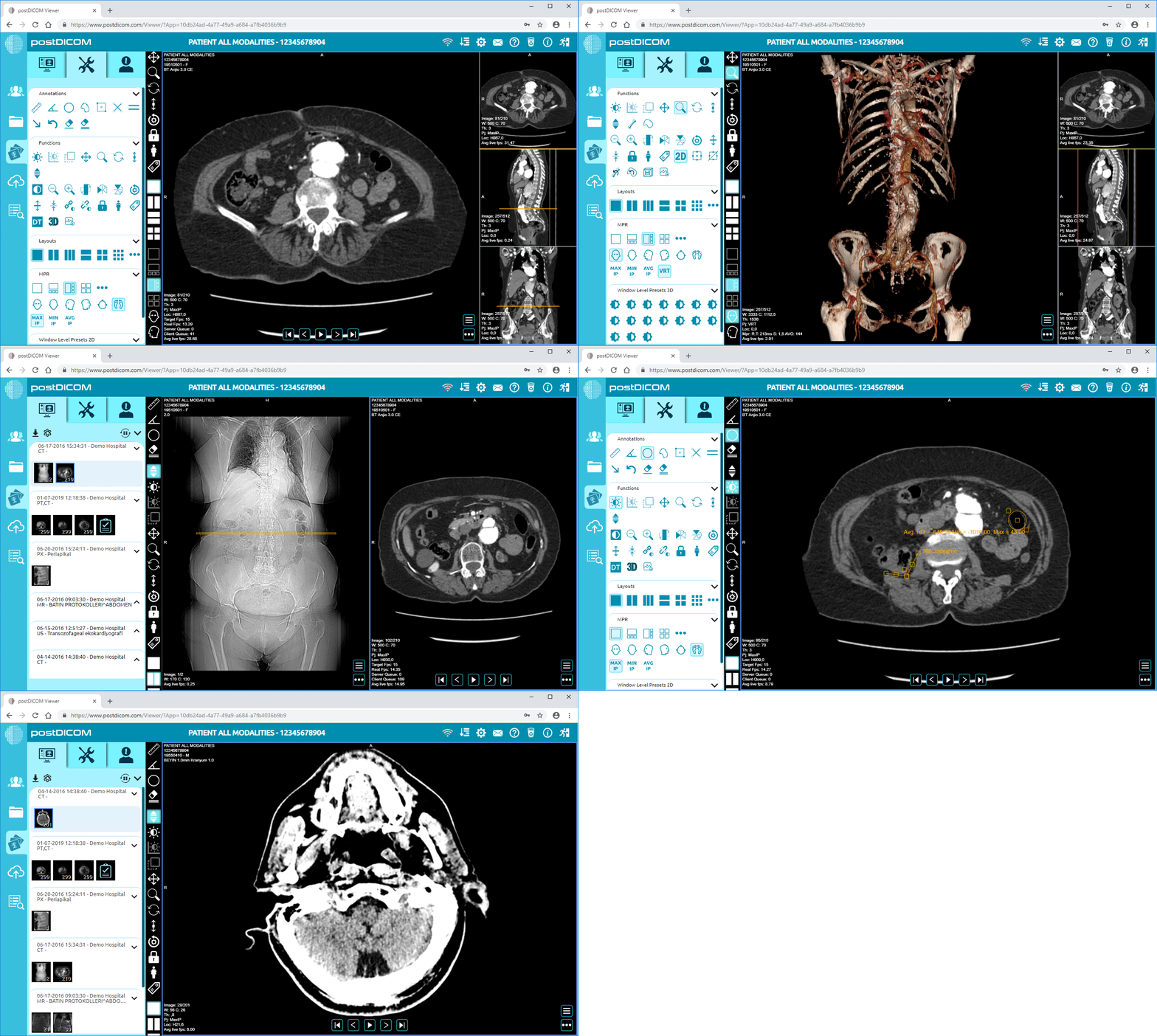
DICOM medical viewers facilitate access, viewing, analyzing and sharing of medical images remotely by medical professionals and thus are indispensable in teleradiology and telemedicine. They facilitate real-time diagnostics, cross-location teamwork, and effective clinical processes, integrating with cloud PACS systems and accommodating image interpretation using a browser without any special localization.
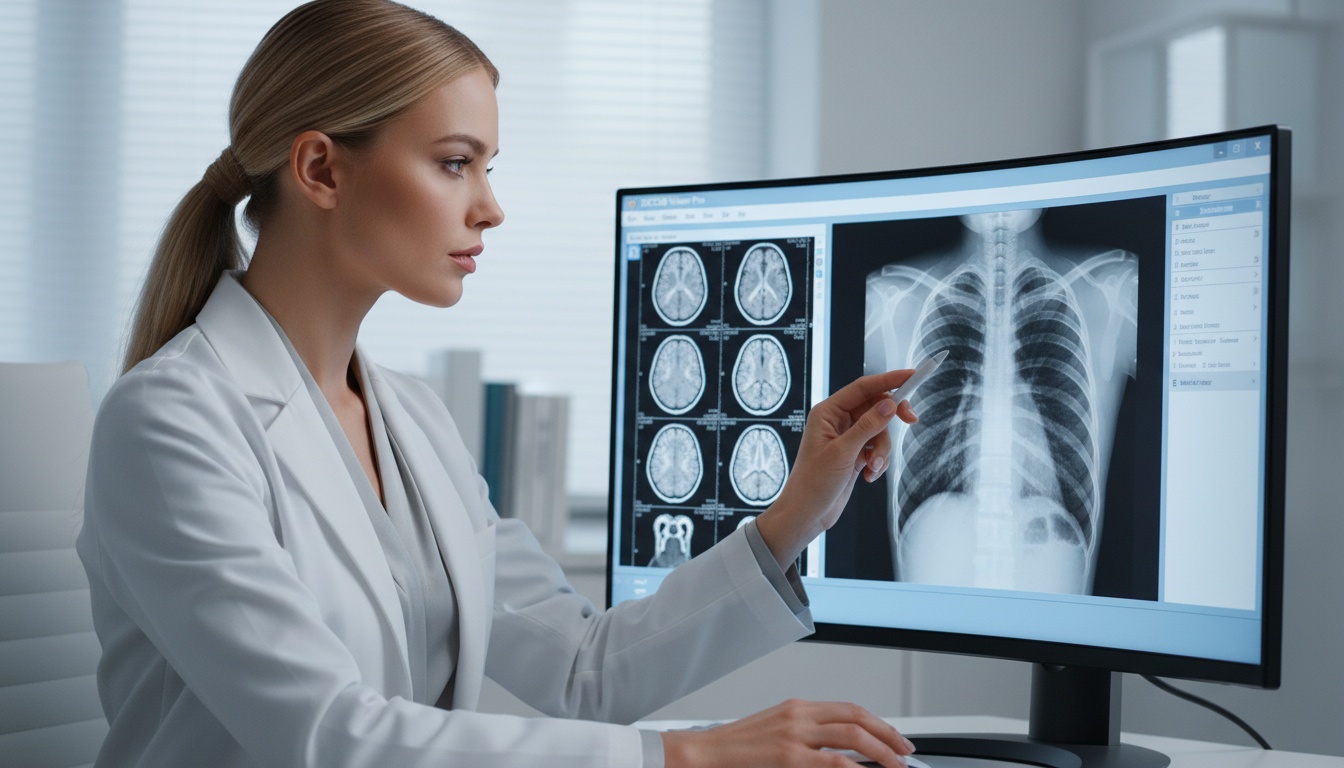
A DICOM medical viewer is a computer program that is used to view, manipulate and process medical images in the Digital Imaging and Communications in Medicine (DICOM) format. These images are produced on modalities like CT, MRI, X-ray, ultrasound, and mammography systems.
Contemporary DICOM viewers are much more than mere image display. They have high-tech features like:
• Multi-planar Reconstruction (mpr)
• 3d Visualization
• Measurement And Annotation Tools.
• Leveling And Windowing.
• Comparative Study Analysis
More to the point, the contemporary viewers are becoming more web-based and cloud-integrated, with the user being able to access imaging data, but not necessarily attached to particular hardware or locality.
In the past, DICOM viewers were mounted on workstations with high performance in radiology departments. Although it worked, this method had drawbacks:
• Limited Access To Certain Physical Sites.
• Expensive Infrastructure And Maintenance Expenses.
• There Is Little Cross-facilities Cooperation.
These restrictions were bottlenecks with the emergence of teleradiology and telemedicine. As a result, DICOM viewers evolved into:
They are installed on-site, are high-performance but not very accessible.
Available in browsers, and without the need to install anything and make it accessible anywhere at distances.
Available in browsers, and without the need to install anything and make it accessible anywhere at distances.
This development has transformed the way imaging processes are carried out in contemporary healthcare systems.
Teleradiology systems are based on the possibility of transmitting and interpreting medical images remotely. DICOM viewers are the key to facilitating this process.
 - Presented by PostDICOM.jpg)
The DICOM viewer is the interface between the radiologist and the imaging data in this workflow. Without it, remote diagnostics would not be possible.
While teleradiology primarily focuses on radiologists interpreting images remotely, telemedicine expands the use of imaging data to a broader clinical ecosystem. Although teleradiology is mainly concerned with radiologists remotely interpreting images, telemedicine extends the application of imaging information to a wider clinical ecosystem. Imaging is increasingly utilized by physicians, specialists, and even multidisciplinary care teams in the process of virtual consultations and remote care delivery.
A typical telemedicine patient-physician interaction is a scenario where a doctor is engaged in a virtual discussion with a patient and is reviewing imaging studies with a DICOM viewer at the same time. Indicatively, an orthopedic specialist can review an MRI scan in real-time as a video call and explain symptoms and treatment options with the patient. This removes delays that in the past used to happen as imaging was to be seen individually or viewed physically.
DICOM viewers facilitate this smooth interaction between telemedicine and imaging, by embodying imaging within telemedicine workflows. They allow:
• Doctors To Discuss Imaging Findings In Real-time Virtual Visits.
• Experts To Work In Different Geographical Areas In Real Time.
• Surgeons To Remotely Review Imaging Prior To Procedures.
• Quick Clinical Decision-making Without The Need To Travel With Patients.
This integration greatly enhances patient experience, minimizes the time of diagnosis turnaround, and improves overall effectiveness of remote healthcare delivery.
Contemporary DICOM viewers are not just images but also enable multifaceted, distributed clinical workflows. The feature set directly influences the diagnostic accuracy, speed and efficiency of collaboration. When considering imaging solutions to be used in a telemedicine and teleradiology setting, it is critical to understand the importance of these features.
The current web-based DICOM viewers do not require software installation and they enable clinicians to view imaging studies at any time, through a browser. This greatly lessens IT dependency and allows users to access images in practically any place without delays in setup.
Radiologists can work with large imaging datasets in a smooth way with high-performance rendering technologies. Modern viewers are able to sustain diagnostic image quality, even over standard internet connections, which is essential to proper interpretation.
Desktops are no longer the binding factor to healthcare professionals. DICOM viewers allow access on laptops, tablets, and mobile devices, leading to flexibility in workflows and quicker response time in urgent care scenarios.
Simultaneous access is one of the most transformative capabilities. It enables radiologists and clinicians to work together in real-time, and the results of their work are enhanced by the possibility of viewing and analyzing the same study by multiple users, which improves decision-making speed and its quality.
The seamless integration will make imaging data not siloed. Patient imaging and clinical records can be accessed by clinicians, enhancing the continuity of workflow and minimizing the chances of making fragmented decisions.
| Feature | Desktop Viewer | Web-Based Viewer | Cloud-Native Viewer |
| Accessibility | Limited to installed device | Accessible via browser | Accessible globally |
| Installation | Required | Not required | Not required |
| Scalability | Low | Moderate | High |
| Collaboration | Limited | Moderate | Advanced |
| Maintenance | High | Low | Minimal |
| Performance | High (local hardware) | Optimized streaming | Cloud-optimized |
This comparison vividly demonstrates the reason why healthcare organizations are becoming enthusiastic to embrace the use of web-based and cloud-native DICOM viewers to utilize remote imaging workflows.
It is best to know the differences- however, which viewer to select is always based on your clinical and operational requirements.
The choice of the type of DICOM viewer will depend on your operational requirements, infrastructure, and workflows. A simplified decision framework is given in the table below:
| Use Case Scenario | Recommended Viewer Type | Reason |
| Remote radiology reporting | Web-based viewer | Enables access from any location |
| Multi-location hospital network | Cloud-native viewer | Supports centralized access and scalability |
| Small clinic with limited IT resources | Web-based viewer | Minimal setup and maintenance |
| High-performance local diagnostics | Desktop viewer | Maximum processing power |
| Telemedicine consultations | Web-based viewer | Seamless integration into virtual care |
Such strategic alignment assists healthcare organizations to select solutions that are attuned to their operational and clinical needs.
 - Presented by PostDICOM.jpg)
The latest DICOM viewer is developed based on high-end web and cloud technologies that can process imaging at high-performance without the need to have the power to process the image locally. Even though the user experience is not complicated, a lot of technical savvy is behind the curtain.
Latency management is one of the most important factors. In remote environments, delays in image loading can impact diagnostic efficiency. Contemporary users solve this by use of streaming and progressive loading so that the image starts to be displayed almost immediately as the rest of the data is loaded in the background.
The optimization of bandwidth is also important. Rather than sending complete imaging datasets at a time, viewers are focused on the relevant parts of the images, which lightens the network load without compromising the quality of the diagnosis. It is particularly significant in rural, or bandwidth-restricted settings.
Moreover, the WebGL and other browser-based rendering technologies enable more intricate image manipulation in the browser. This does not require expensive local hardware, and can still support advanced visualization methods such as 3D rendering and multi-planar reconstruction.
Combined, these technologies make sure that clinicians are able to obtain the same performance as that of workstations in fully remote settings that is vital to scale telemedicine and teleradiology services.
The major enabling technologies of modern DICOM viewers are the DICOMweb protocols (WADO, QIDO, STOW), streaming, the use of GPUs to perform rendering (WebGL), and sophisticated compression. The combination of these technologies guarantees access to high-performance images in a distributed environment efficiently.
The security of patient data is essential in telemedicine and teleradiology. Contemporary DICOM viewers have several levels of security:
• Encryption Between The Client And Server (https, Tls).
• Role-based Access Control
• Audit Trails And Activity Logging
• Adherence To Regulations, Including HIPAA And GDPR.
These are safety measures that make sure that even sensitive medical imaging data is safe even when accessed offsite.
• Increased Access To Imaging Studies.
• Improved Workflow Efficiency.
• Remote Working Ability.
• Increased Interdepartmental Cooperation.
• Rapid Diagnosis And Treatment.
• Less Wait Time Of Patients.
• Lower Infrastructure Costs
• Scalable Imaging Solutions
• Improved Service Delivery
Artificial intelligence is fast changing the way imaging data is analyzed and used in healthcare systems. Instead of substituting radiologists, AI complements their functions by serving as a decision-support layer in DICOM viewers.
Indicatively, AI algorithms may automatically point out possible abnormalities, e.g., nodules, fractures, or lesions, before the radiologist starts their examination. This enables clinicians to concentrate on the cases that are critical and minimize the chances of oversight especially in settings with large volumes.
The AI also helps in optimizing workflow. In a teleradiology facility where cases are constantly being received, AI can sort the cases according to urgency, meaning the life-threatening cases should be addressed first. This directly affects patient outcomes particularly emergency situations.
With the ongoing evolution of the AI integration, DICOM viewers are not just visualization tools anymore, but are shifting to be intelligent diagnostic platforms, which can help make clinical decisions faster and more accurately.
Despite the enormous benefits of DICOM viewers, there are a number of operational and technical issues that healthcare organizations need to confront when adopting these tools.
• Internet Bandwidth Limitations: In areas with lower connectivity, performance of image loading can be compromised and optimization methods like compression and caching are needed.
• Integration With Legacy Systems: In most cases, healthcare providers use older infrastructure and thus the process of integrating with the new cloud-based viewers is rather resource-demanding and complicated.
• User Training And Adoption: To move out of traditional desktop-based systems, to web-based views, requires training so that clinicians can take advantage of the new features fully.
• Regulatory Compliance Across Regions: Healthcare providers working in more than one jurisdiction should make sure their data protection policies are in line with different regulations.
Such challenges should be dealt with in advance to have a successful and scalable telemedicine imaging strategy.
The future of DICOM viewers is highly connected with the development of cloud computing, AI, and interoperability standards.
We can expect:
• Deeper Ai Integration
• Real-time Global Collaboration
• Enhanced Mobile Capabilities
• Enhanced Integration With Health Systems.
With the ongoing development of telemedicine, DICOM viewers will be an indispensable part of the digital healthcare infrastructure.
The creation of cloud-based DICOM viewing solutions offered by platforms such as PostDICOM is in line with the modern healthcare requirements. Having web-based access, secure cloud storage, and more sophisticated visualization tools, these platforms allow healthcare providers to introduce efficient teleradiology and telemedicine processes without intricate infrastructure.
A web-based DICOM viewer enables users to access medical images in a web-based viewer without any software.
Yes, the contemporary audience is optimized towards mobile access, allowing the clinicians to check images on smartphones and tablets.
Yes, they can be implemented to comply with healthcare security standards, with encryption and access controls.
They interrelate through such protocols as DICOMweb to access and view images stored in PACS systems.
Zero-footprint viewing implies that no software has to be installed at all and all the functionality is in-the-browser.
Yes, lots of contemporary viewers incorporate AI to analyze images and optimize workflows.
Most contemporary viewers are optimized to run effectively on typical broadband networks
Yes, cloud-based viewers can be used to facilitate real-time collaboration among the users.
DICOM viewers provide the ability to share an imaging study among multiple users and interact with the same study at once, ensuring a team can more quickly consult and make decisions.
The web-based viewers are concerned with accessibility through a browser whereas cloud-based viewers belong to a bigger cloud infrastructure that encompasses storage, scalability, and accessibility across the globe.
Yes, the web-based solutions, in particular, where the infrastructure is minimal, and access to high-quality imaging is economical.
|
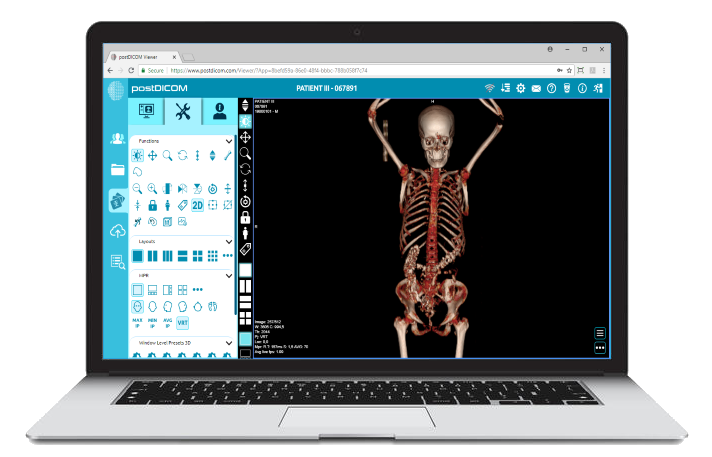
Cloud PACS and Online DICOM ViewerUpload DICOM images and clinical documents to PostDICOM servers. Store, view, collaborate, and share your medical imaging files. |