Radiology operates at the intersection of precision, speed, and safety. Every scan follows a defined protocol, every handoff depends on clarity, and every image must be traceable across the workflow. Yet, when new imaging technology or cloud PACS systems are introduced, training inconsistencies can quickly emerge. A single overlooked update or outdated instruction can ripple through an entire department, leading to inefficiencies and potential errors.
A Learning Management System (LMS) provides a structured, measurable approach to maintaining protocol consistency, staff competency, and compliance. It ensures that radiology professionals receive standardized, trackable, and role-specific training that evolves alongside the technology they use daily.
Radiology departments handle constant change. Equipment updates, revised imaging guidelines, new compliance mandates, and cloud-based workflows require frequent retraining. When communication relies on emails or meetings, essential information often gets lost or delayed between shifts and sites.
An LMS replaces that fragmented approach with a centralized training environment. Every policy update, safety checklist, or imaging guideline becomes a verified learning module, ensuring that all team members work from the same information at the same time.
Consistency in training translates directly into consistency in patient care. When every technologist and radiologist follows the same validated process, diagnostic quality improves, compliance gaps shrink, and workflow interruptions decrease.
Radiology onboarding involves far more than general hospital orientation. Staff must learn imaging protocols, contrast administration guidelines, dose-optimization procedures, and system-access workflows. An LMS organizes these elements into role-based modules: short, interactive, and focused on critical competencies. New hires or locum staff can become productive faster, while supervisors gain visibility into completion status and performance.
Multi-site imaging organizations often experience protocol drift, where small variations in practice accumulate over time. An LMS eliminates this by hosting the authoritative version of each imaging protocol and linking it directly to structured learning. Updates are instantly distributed and acknowledged, keeping every site aligned. This standardization supports uniform image quality and simplifies audits when accreditation bodies require proof of compliance.
Healthcare organizations face constant scrutiny from regulatory agencies. Radiology departments, in particular, must demonstrate adherence to HIPAA, radiation safety, and contrast administration standards. An LMS maintains detailed records such as completion logs, timestamps, and version control, making documentation effortless during audits or internal reviews.
For reference, the U.S. Department of Health and Human Services' HIPAA Guidelines provide essential guidance on data privacy in medical imaging workflows.
Many procedural errors stem not from negligence but from inconsistent training. When staff rely on memory or outdated notes, critical steps can be missed. By connecting every workflow update to a verified learning module, an LMS ensures that the most current procedures are understood and acknowledged by all personnel. This reduces re-scans, reporting delays, and patient risk.
For additional guidance on patient safety, see the Agency for Healthcare Research and Quality (AHRQ) patient safety resources.
Continuous learning is vital in imaging departments. New protocols, modalities, and compliance updates emerge regularly. An LMS simplifies ongoing education by automatically assigning refresher courses at defined intervals. It can also integrate with credentialing requirements, ensuring that professional certifications remain up to date.
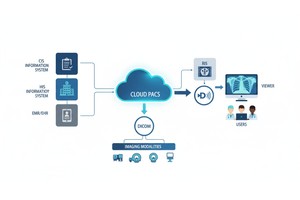
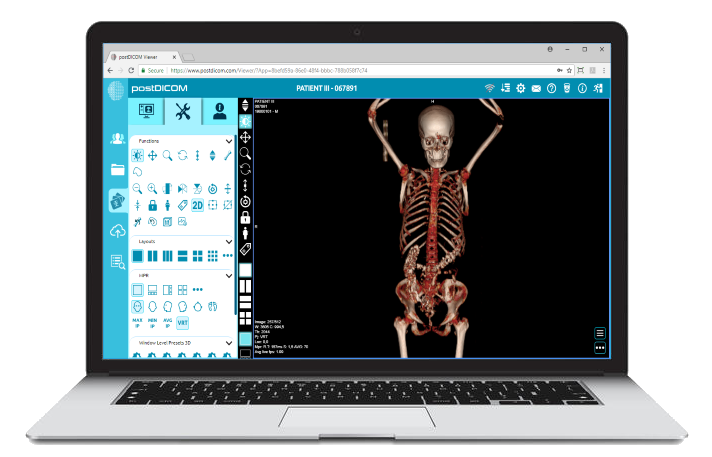
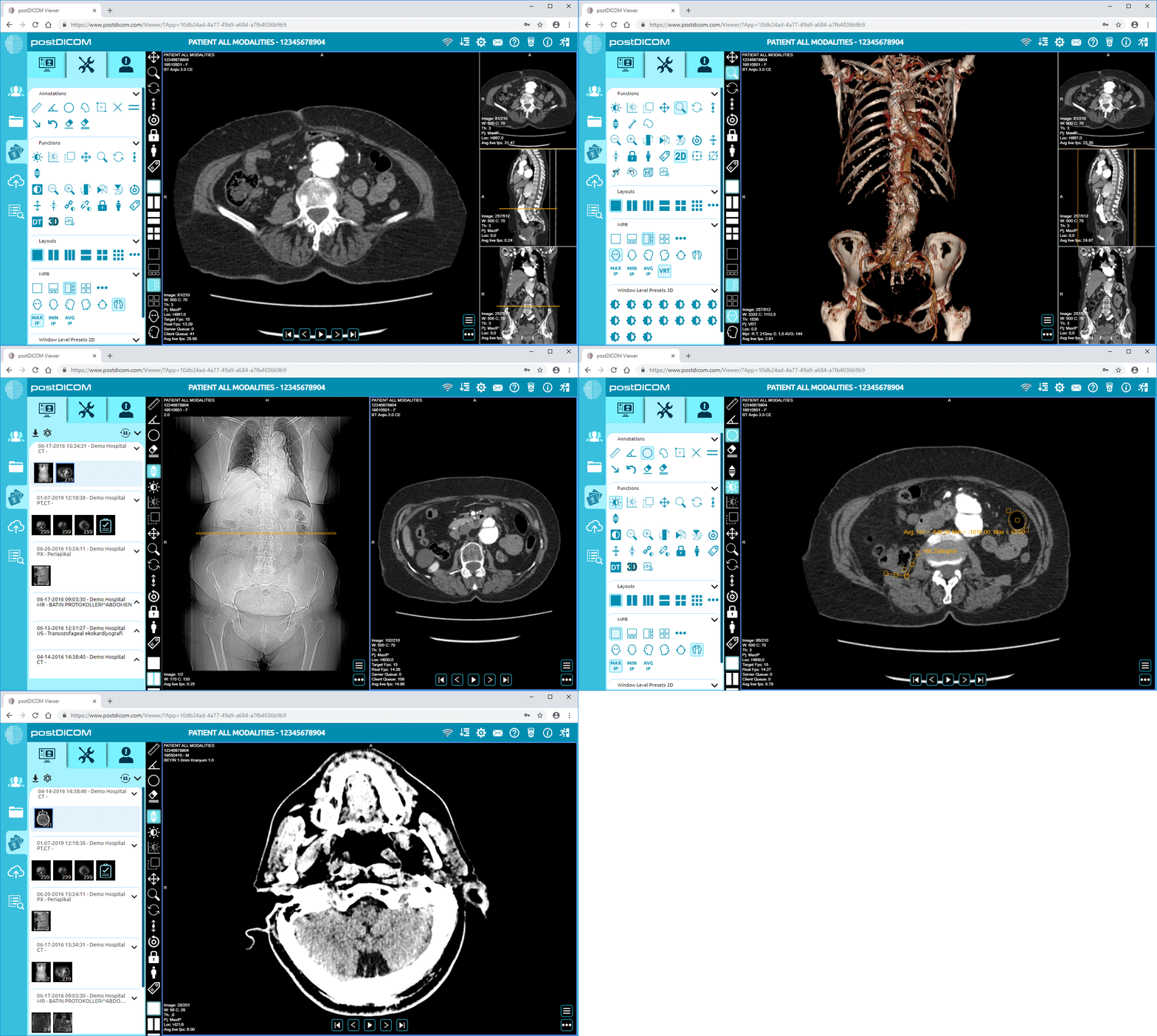
The shift to cloud-based PACS platforms, such as PostDICOM, has transformed how radiology departments manage and share studies. While cloud PACS improves accessibility and scalability, it also introduces new workflows and security requirements that every user must clearly understand.
An LMS bridges the gap between technology implementation and user proficiency. Training modules can cover:
• Secure Access And Data-sharing Policies
• Cloud Storage And Retrieval Workflows
• Standard Naming And Documentation Procedures
• Role-based Permissions And Compliance Measures
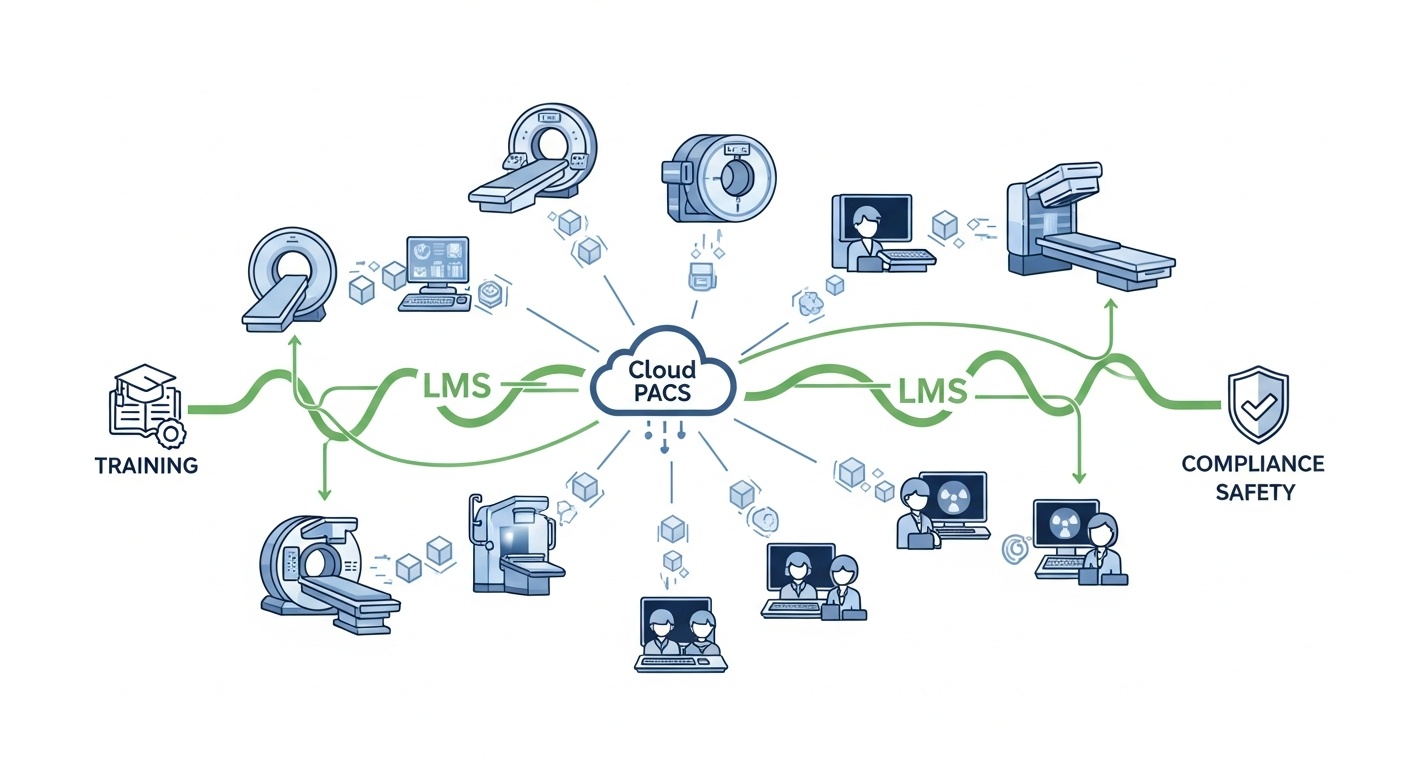
During cloud PACS rollouts, the LMS serves as the unified training source that aligns teams on both operational and compliance standards. This ensures the transition enhances efficiency without compromising data security or clinical accuracy.
 - Created by PostDICOM.jpg)
Start by prioritizing protocols with the highest variability or safety risk like contrast administration, dose management, and image labeling are common examples. Establish a baseline for current practices before developing learning materials.
Instead of publishing long policy documents, translate protocols into brief, scenario-based lessons. For instance, when training for contrast media administration, modules can include case examples, decision trees, and quick quizzes referencing the ACR Manual on Contrast Media.
This format reinforces clinical decision-making and helps staff retain information relevant to their role.
Radiologists, technologists, nurses, and administrative staff interact with imaging protocols differently. Role-based paths prevent information overload and improve completion rates.
For example:
• Technologists Focus On Patient Preparation, Scanning Technique, And Contrast Safety.
• Radiologists Emphasize Reporting Standards, Peer Review, And Dose Interpretation.
• Managers Review Compliance Reports And Audit Readiness.
Some skills, such as IV contrast administration or scanner setup, require in-person validation. The LMS can document digital completion while managers record observational sign-offs, creating a full record of both knowledge and performance competency.
Whenever a protocol is updated, the LMS should automatically archive previous versions and highlight changes in plain language. A simple “What Changed” summary ensures staff immediately understand updates without re-reading the entire procedure.
When evaluating a learning management system, radiology departments should look for features that support:
• Role-based Assignments And Granular Reportingby Site Or Modality
• Microlearning Formatssuitable For Busy Clinical Schedules
• Integrationwith Hr Or Credentialing Databases
• Mobile Accessfor Staff Working Across Shifts Or Remote Sites
• Automated Remindersfor Compliance Deadlines
An LMS with these capabilities not only simplifies training but also becomes part of the department’s quality assurance ecosystem.
A cloud PACS streamlines image access and storage, while an LMS ensures the people using those systems operate under uniform standards. Together, they create a sustainable model for digital transformation in radiology.
When imaging protocols, security practices, and user workflows are reinforced through structured training, departments experience fewer errors, faster onboarding, and stronger regulatory compliance. The result is a radiology operation that scales safely, without losing the discipline that defines quality care.
A modern LMS equips radiology teams to stay aligned with evolving protocols, supports safe adoption of cloud PACS systems, and delivers measurable improvements in compliance and patient care.
In a field where every image counts, standardized learning ensures that the people behind those images perform with the same precision as the technology itself.
|
Cloud PACS and Online DICOM ViewerUpload DICOM images and clinical documents to PostDICOM servers. Store, view, collaborate, and share your medical imaging files. |